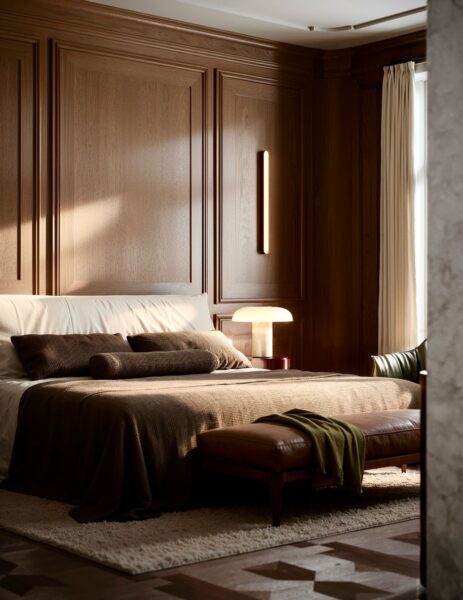
I want to tell you about the moment I walked into a wood-drenched room for the first time and genuinely stopped talking mid-sentence. It was a bedroom. Walnut panels on the walls, walnut planks on the ceiling, warm oak floors running underneath—a single linen duvet. Brass wall sconces are throwing soft light across all that grain. No art. No clutter. Just wood and light and the kind of quiet that makes you want to sit down and stay.
I stood there thinking — this is what a room is supposed to feel like.
That was two years ago. Since then, wood drenching has gone from a technique I saw in high-end residential projects to the most searched interior design trend of 2026. And I get why. After years of white walls, gray everything, and interiors that looked more like Apple stores than homes, people are done with cold. They want warmth. They want texture. They want to feel something when they walk into a room.
Wood drenching does that better than almost anything else in the designer’s toolkit.
First, what actually is wood drenching?
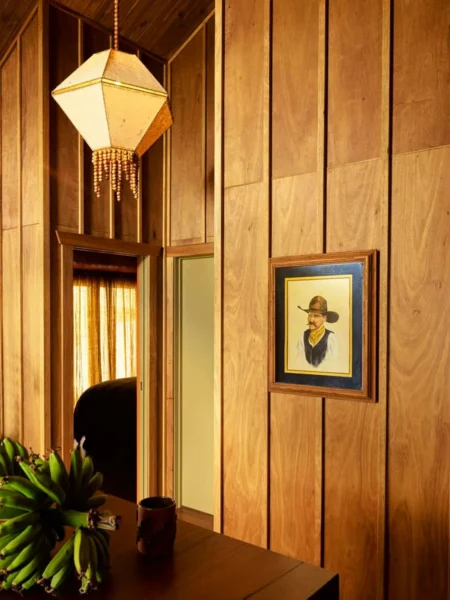
The concept is simple. Instead of using wood as one element in a room – a floor here, a coffee table there, you use it as the dominant material across multiple surfaces. Walls. Ceiling. Floors. Built-ins. Sometimes furniture. All working together in the same species or closely related tones to create a space that feels immersive, cohesive, and deeply connected to something natural.
Think of it as the timber version of color drenching – that trend where designers coat every surface in one rich paint color. Same logic, different material. Except wood brings something paint never can: grain, variation, depth that changes throughout the day as light moves across it.
It’s also called timber bathing, which I actually prefer. Because that’s what a truly well-executed wood-drenched room feels like: stepping into something that wraps around you.
Kendall Jenner’s Wyoming Airstream – redesigned by the brilliant Heidi Caillier – became the image that put this trend on everyone’s radar at the start of 2026. But this isn’t a celebrity moment. This is a genuine design shift that’s been building for years in high-end residential projects across Europe and the Pacific Northwest, and it’s now completely accessible to anyone willing to understand the principles.
Which is exactly what we’re going to cover……….
Why wood drenching isn’t just a trend
I’m going to be honest with you: I don’t get excited about every trend that cycles through the design world. A lot of them are just visual noise — things that photograph well on Instagram and look tired twelve months later.
Credit: PinterestCredit: Pinterest
Wood drenching is different, and here’s why I believe it has genuine staying power.
It works on a biological level. There’s a growing body of research on biophilic design – the idea that humans are hardwired to feel better when they’re surrounded by natural materials. Wood specifically has been shown to reduce cortisol (your stress hormone), lower blood pressure, and create a measurable sense of calm. This isn’t aesthetic preference. This is physiology. A timber-rich room doesn’t just look good – it makes you feel different. That’s not something a trendy paint color can replicate.
It improves with age. This is the part that genuinely separates wood drenching from most design trends. A walnut-paneled room at ten years looks richer than it did on day one. The grain deepens. The patina settles. The material develops character. Compare that to a jewel-toned paint color or an on-trend tile pattern, both of which have a shelf life. Wood doesn’t date. It evolves.
It’s a values statement. As homeowners become more conscious about how they spend and what they build, there’s real meaning in choosing a sustainably sourced, FSC-certified, or reclaimed timber for a major design decision. Reclaimed wood, especially – every plank has grain variation, natural imperfection, sometimes nail holes or saw marks from a previous life. That history is part of the beauty. It’s the opposite of the anonymous, mass-produced interior, and people are responding to that.
The choice that changes everything: your wood species
Here’s where I see designers — and DIYers — go wrong most often. They find an image they love, decide they want to “do wood drenching,” and then pick a species based on what’s available at their local lumberyard or on sale.
Don't do that.
Your wood species is the single most important decision in this entire process. It determines the mood, the weight, and the personality of the room. Get it right, and everything else falls into place. Get it wrong, and no amount of good furniture or lighting will save you.
Light woods: White Oak and Ash
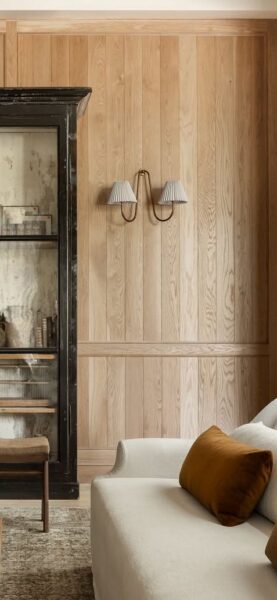
White oak is having its biggest moment in years, and I don’t think it’s going away anytime soon. The reason designers love it is the undertone — it sits in that warm-but-not-yellow zone that plays beautifully with almost everything. Linen, stone, brass hardware, and concrete. It’s clean without being cold. Modern without being clinical.
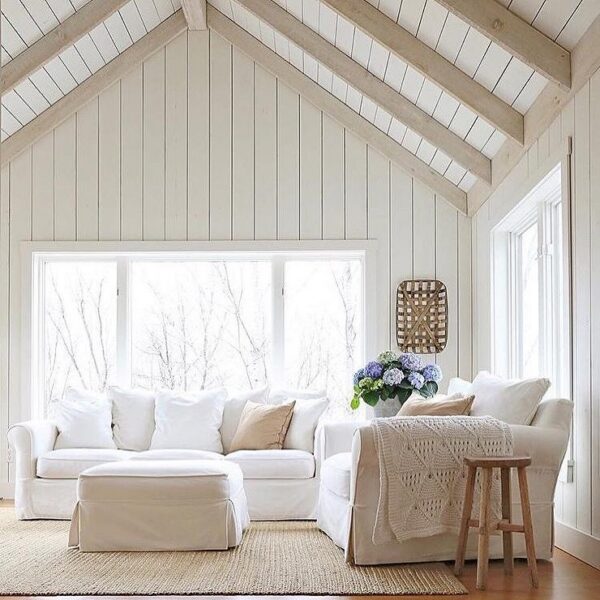
Ash runs slightly cooler and lighter, with a white undertone that makes it exceptional for custom finishes – if you want to tint toward gray, or warm it slightly toward honey, ash takes stain and oil beautifully. Both woods have an open grain that catches light, making them feel alive throughout the day. In a morning room or a south-facing space, white oak in particular is just extraordinary.
Use these when you want a space that feels both fresh and warm. Contemporary kitchens. Open-plan living rooms. Bedrooms that lean towards Japandi or coastal. Any room that gets good natural light.
Mid-tone woods: Cherry and Smoked Oak
Cherry is one of those materials that rewards patience. When it’s new, it’s a light pinkish-tan – pretty but not dramatic. Give it a year of light exposure, and it deepens to a gorgeous amber-brown that no stain can replicate. That living quality makes it exceptional for spaces you plan to keep for a long time.
Credit: Studio McGee
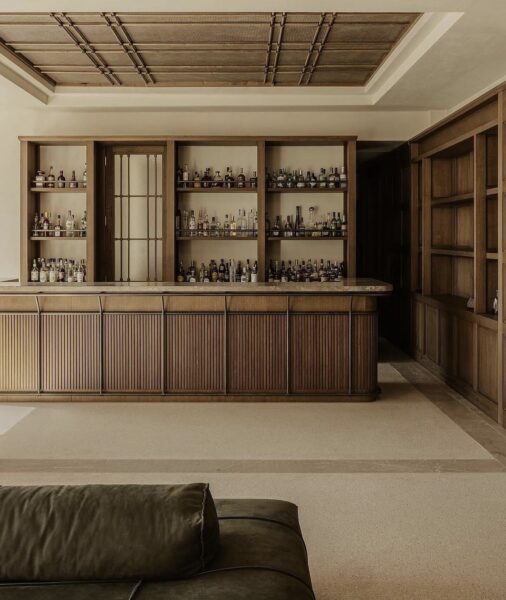
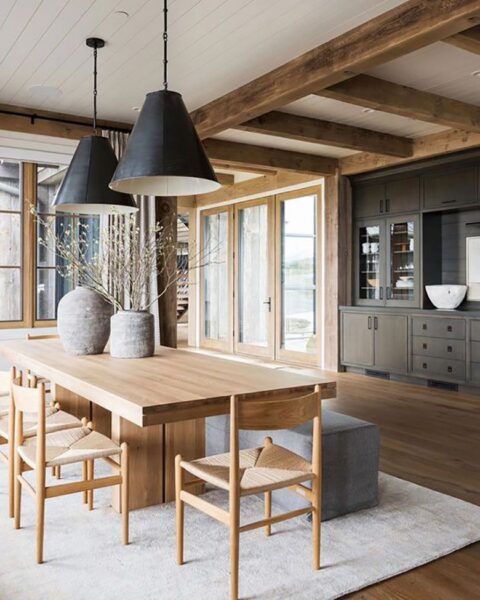
Smoked oak is the designer’s secret weapon in 2026. It’s white oak that’s been heat-treated — the process darkens the grain dramatically, giving it the richness of walnut without the cost or the weight. The result is something that beautifully bridges contemporary and traditional. I’ve seen it in dining rooms that look like they cost twice as much as they did.
Use these when: You want warmth and sophistication without going full dark and moody. Dining rooms, home libraries, transitional bedrooms. Rooms that need to feel grown-up without feeling heavy.
Dark woods: Walnut and Mahogany
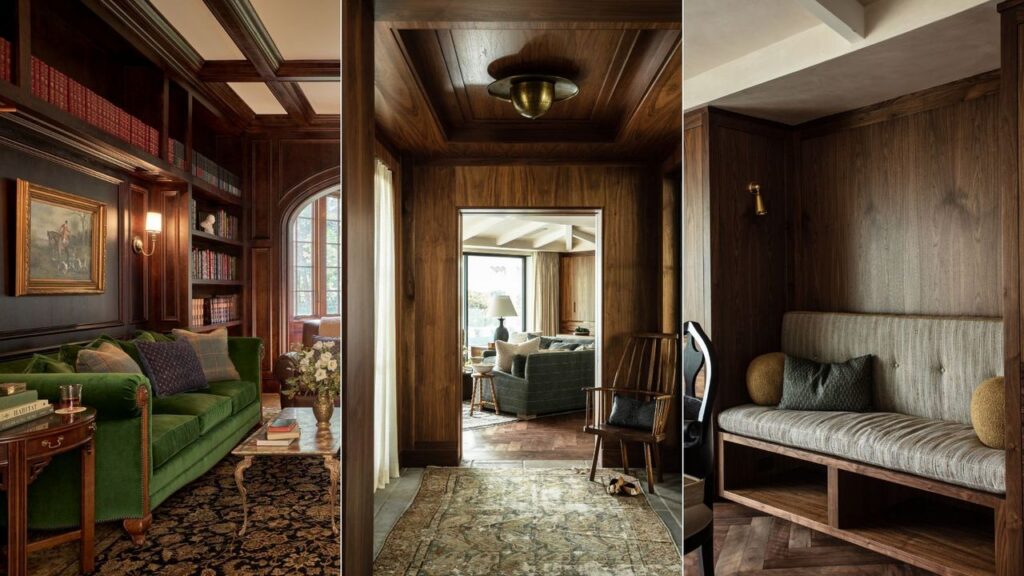
Walnut is the one I keep coming back to. It’s the only domestic hardwood with that particular combination of chocolate-brown depth, purple-gray undertones, and a grain pattern that’s striking without being busy. A walnut-drenched room — panels on the walls, floors beneath, warm brass sconces — feels like the most expensive room you’ve ever been in. And it doesn’t have to be.
Credit: lifestyleminteriordesign
Mahogany runs warmer and redder than walnut, with a more formal character. It suits traditional, Victorian, and mid-century spaces extraordinarily well. Both dark woods need thoughtful handling. They’re not for every room or every light condition. But when they’re right, nothing else comes close.
Use these when: You want drama, luxury, and a deeply cocooning atmosphere. Master bedrooms. Home offices. Dining rooms where you want people to feel like the dinner is a special occasion. Spaces with good natural light or rooms where you want to lean into the darkness intentionally.
The one rule about mixing tones
You don’t have to use one species for everything. In fact, using a single species and finishing on every surface in a room often looks flat and manufactured — like a furniture showroom floor rather than a real home. What designers do instead: choose a dominant tone for the large surfaces (walls, floor, built-ins) and layer in complementary species through furniture and accents. The key is staying within the same warmth family.
A combination I love right now:
White oak wall paneling → smoked oak dining table → walnut shelving accents → brass hardware
Three species. All warm-toned. Each one occupies a different scale in the room. Together, they create depth and layering that a single-species approach simply can’t.
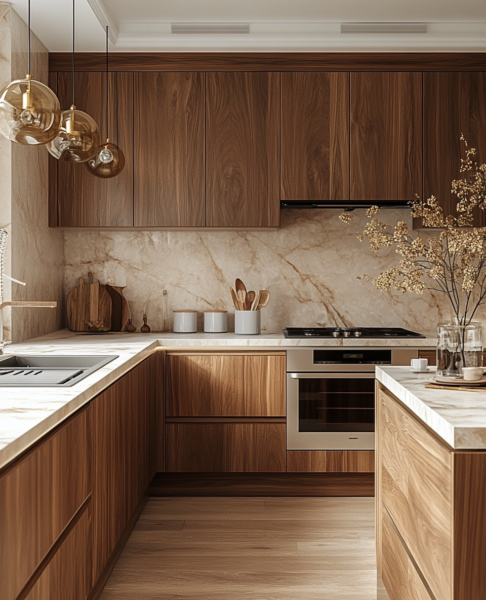
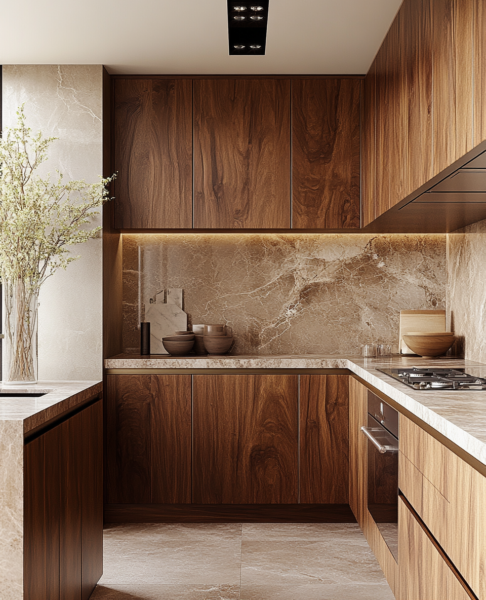
I always recommend the kitchen as the starting point, because you’re already working with cabinetry — and cabinetry gives you enormous surface area to work with before you’ve added a single panel to a wall.
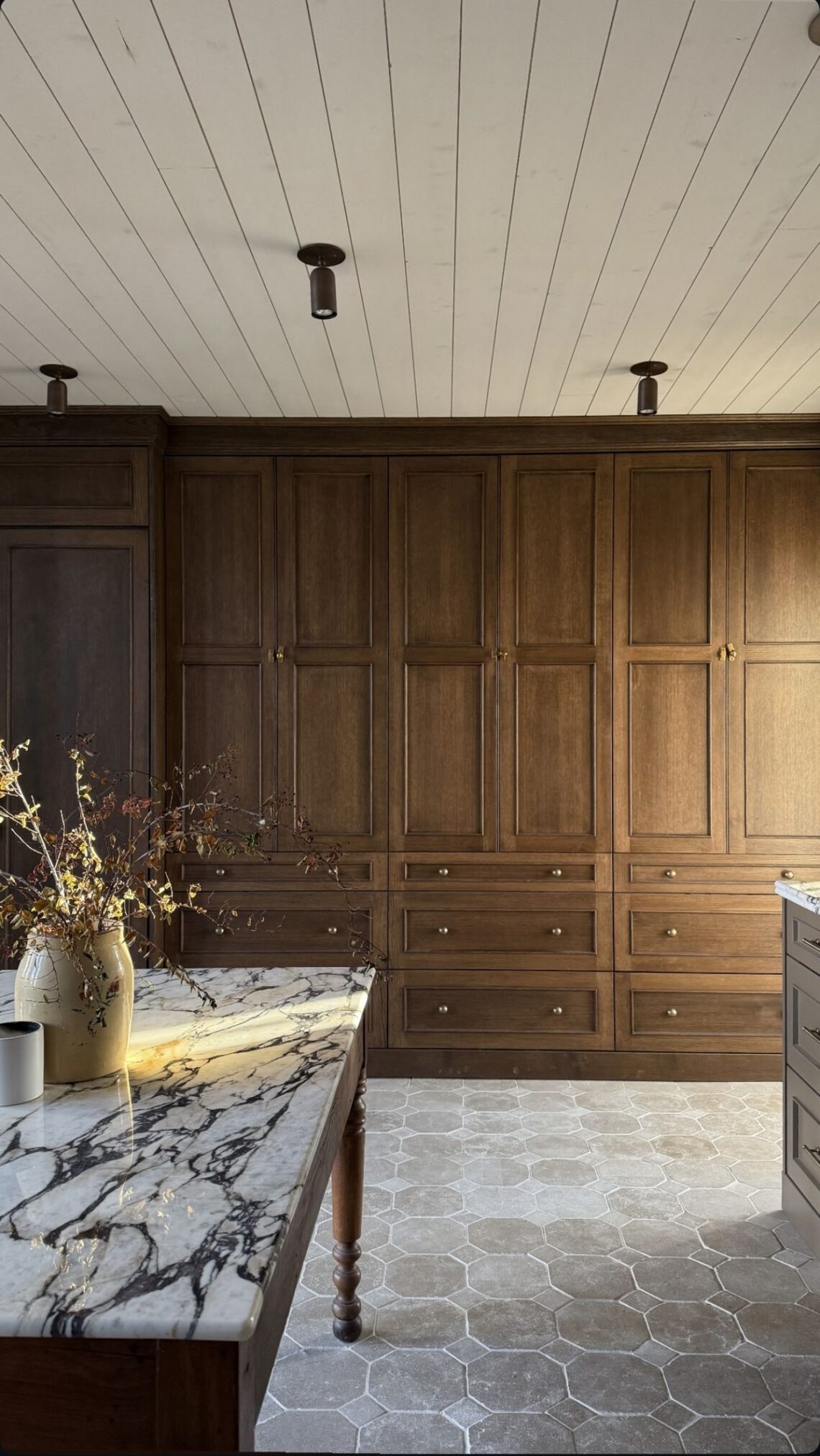
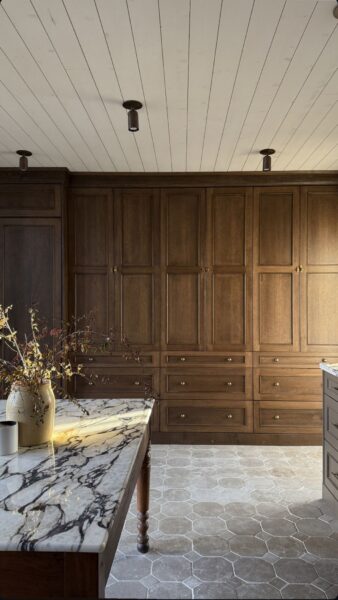
The move that’s dominating high-end kitchen design in 2026 is the wood-clad ceiling. Run tongue-and-groove planks across the kitchen ceiling in the same tone as your cabinetry, and you’ve instantly transformed an ordinary kitchen into something architectural. It takes a room that photographs flat and makes it feel like a place.
Match your cabinet finish to your floor in warmth level — not necessarily the same species, but the same temperature. A cool-toned ash cabinet over a warm honey oak floor will always feel slightly off, even if you can’t immediately identify why. Keep the warmth consistent, and the room will feel unified even if the materials differ.
Credit: PinterestCredit: Pinterest
The bedroom
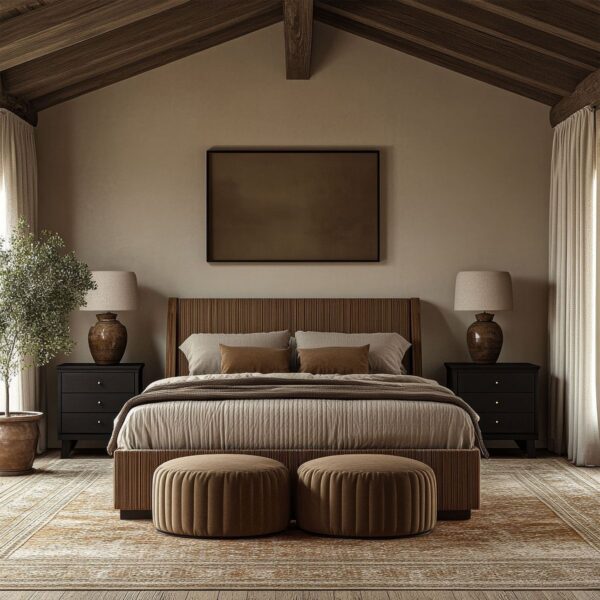
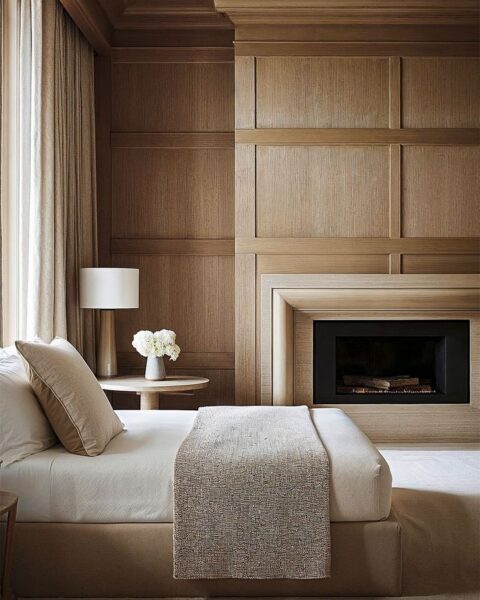
This is, honestly, where wood drenching earns its reputation. There’s something that happens when you sleep in a room surrounded by natural timber that’s genuinely hard to describe until you’ve done it. The room is quieter — not acoustically, but psychologically. The wood absorbs the visual noise. You wake up differently.
Credit: VT Design
Start with the headboard wall. A panel of walnut or smoked oak behind the bed is one of the highest-impact, lowest-complexity changes you can make to a bedroom. It immediately makes the bed feel intentional — like it belongs somewhere specific rather than just sitting against a painted wall.
If you want to go further, extend the paneling to the ceiling. This is the full cocoon, and it is extraordinary.
The living room
In open-plan living rooms, wood drenching solves a problem that paint rarely can: it creates zones without walls.
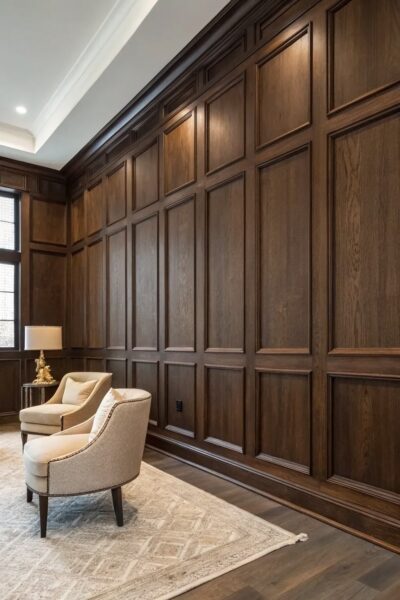
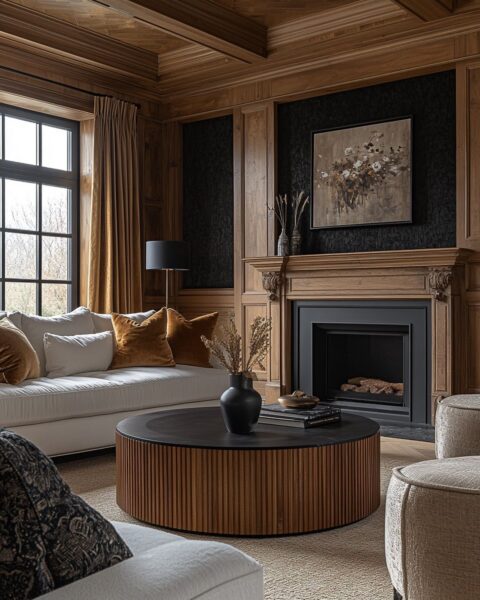
A paneled feature wall behind the sofa — even in a large, open space — immediately defines the seating area as its own place. It gives the room an anchor. Extend that paneling to wrap around a fireplace, and you’ve created an architectural moment that becomes the heart of the whole floor.
Credit: DecorPad
One thing I want to be clear about: don’t panel all four walls in a living room unless the space is genuinely generous and you’re prepared to balance it heavily with soft furnishings. Four tight wood walls in a small room cross from cocoon into cave very quickly. One or two walls, thoughtfully chosen, is the sweet spot for most living rooms.
The bathroom
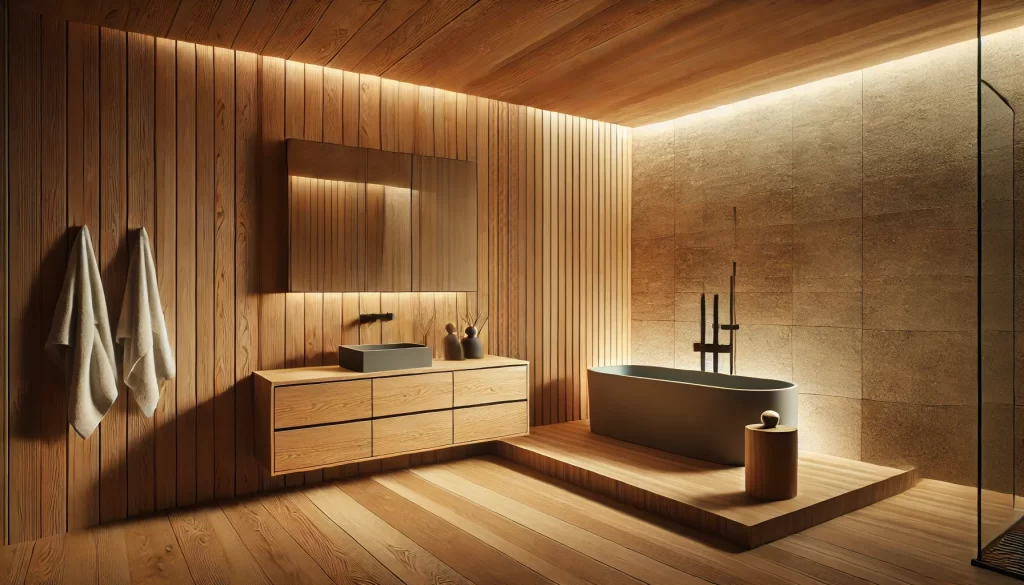
A wood-drenched bathroom is the closest thing to a spa you can create at home without major construction — and it’s more achievable than most people think.
Teak is your material for wet zones: it’s naturally moisture-resistant and has been used in marine environments for centuries. For dryer areas — the vanity wall, a mirror surround, open shelving — white oak and walnut are both beautiful, as long as they’re properly sealed.
Credit: Studio Zung
The effect of natural timber in a bathroom is something you have to experience to fully understand. It changes how the room smells, how the light feels, how you feel in it. There’s a reason every high-end spa in the world has wood in it.
The ceiling: the surface everyone is ignoring
I want to dedicate a separate section to this because it’s the thing that makes the biggest difference and the thing most people skip.
The ceiling is the fifth wall. In wood drenching, it’s often the most transformative surface you can touch.
Run oak planks across a bedroom ceiling, and suddenly the room has dimensions it never had before. Install tongue-and-groove over a kitchen island, and the whole space feels architectural. Bring walnut panels up from a headboard wall and across the ceiling, and you’ve created something that doesn’t look like anything else in your neighborhood.
Credit: Studio McGee
The reason designers love the ceiling is that it changes the room without taking up any floor space. In a small room, a wood ceiling adds richness and dimension while maintaining the same footprint. In a large room, it draws the eye up and gives the space a sense of enclosure, making it feel more intentional.
If you’re only going to add wood to one surface, make it the ceiling.
A quick reference before you start
Wood
Tone
Room Sweet Spot
Pairs With
White Oak
Light, silvery-warm
Kitchen, living room, open spaces
Linen, stone, brass, concrete
Ash
Very light, cool-neutral
Contemporary spaces, work areas
Matte black, glass, plaster
Cherry
Mid-tone, amber-warm
Dining room, study, library
Aged brass, leather, deep jewel tones
Smoked Oak
Mid-dark, rich
Bedroom, dining room, library
Cream, dark metal, stone
Walnut
Dark chocolate
Bedroom, home office, formal dining
Cream upholstery, stone, brushed brass
Mahogany
Dark reddish-warm
Traditional or formal rooms
Deep colors, antique brass, velvet
Here’s where I’d start if this were my room
If I were walking into a standard home — nothing special architecturally, maybe some uninspiring painted walls, a decent floor — and I wanted to bring wood drenching in without blowing the budget or making irreversible decisions, here’s exactly what I’d do:
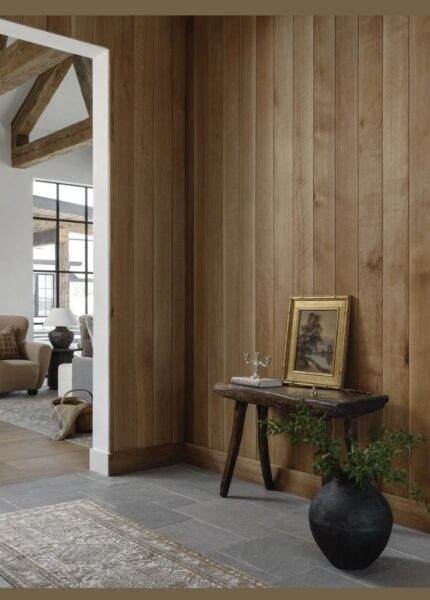
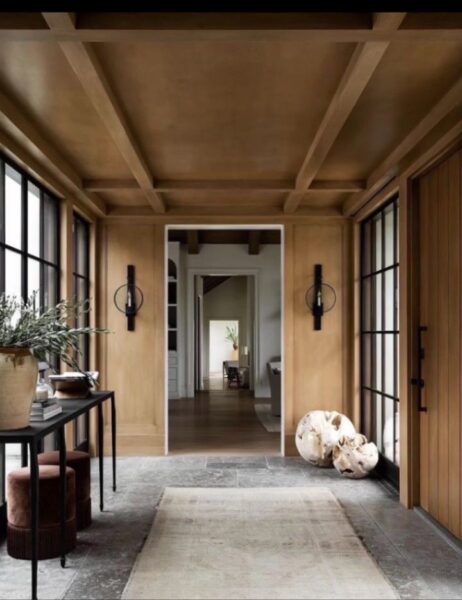
I’d start with the ceiling, entryway, or any small space
Credit: PinterestCredit: Studio Mcgee
And I guarantee that room would feel completely different. The kind of difference where people walk in and ask what you did without being able to immediately identify it. From there, I’d add the Ceiling wall. Then maybe shelving in a complementary species. Then I’d see where it wanted to go. Wood drenching doesn’t have to be an all-or-nothing commitment. It’s a direction you can move in gradually, layer by layer, until the room feels exactly the way you want it to.
Final thought
I’ve been in a lot of beautiful rooms. Rooms with expensive furniture, rare materials, and extraordinary art. And some of those rooms were genuinely impressive — but not all of them made me feel anything.
The best rooms I’ve ever been in had natural material at their core. Wood, stone, linen, light. Things that connect to something older and more essential than interior design trend cycles. Wood drenching, when it’s done with intention, is that kind of room. It’s not trying to impress you. It’s trying to make you feel at home.
Start with one surface. See how it feels. Then tell me about it in the comments — I read every one, and I genuinely love hearing what you’re working on.
Если вы ищете надежный автосервис для вашей Тойота в Москве, вам повезло. Специалисты готовы осуществлять ремонт и обслуживание ваших автомобилей.
Если вам нужен качественный и надежный автосервис Toyota, мы предлагаем широкий спектр услуг для вашего автомобиля.
Работа с автомобилями этой марки требует особого подхода. Все работники имеют соответствующую квалификацию и опыт.
Техническое оснащение сервиса соответствует самым высоким стандартам. Наличие современного оборудования существенно упрощает процесс диагностики.
Наш автосервис обеспечивает надежность и долговечность вашего автомобиля. Ваше доверие для нас — наивысшая награда.





One Comment
Avtoservis_zdPr
Если вы ищете надежный автосервис для вашей Тойота в Москве, вам повезло. Специалисты готовы осуществлять ремонт и обслуживание ваших автомобилей.
Если вам нужен качественный и надежный автосервис Toyota, мы предлагаем широкий спектр услуг для вашего автомобиля.
Работа с автомобилями этой марки требует особого подхода. Все работники имеют соответствующую квалификацию и опыт.
Техническое оснащение сервиса соответствует самым высоким стандартам. Наличие современного оборудования существенно упрощает процесс диагностики.
Наш автосервис обеспечивает надежность и долговечность вашего автомобиля. Ваше доверие для нас — наивысшая награда.